|
TRIBE
OF SIMEON
IRELAND
Because
the Lord hath heard that I [Leah] was hated, he hath therefore given me
this
son also: and she called his name Simeon, as his name means 'heard'.
Leah was
hated - the Irish were also hated in America. The name, Leah, did not
mean
'weary' as some have indicated, but rather, her name means 'inpatient'
or
'grieved'. Leah was surely grieved and impatient.
LEAH: #3811 la'ah
law-aw'
name means, to tire; to be, or make disgusted, faint, grieve, lothe, to
be or
make weary. BUT also Leah means to be impatient, be offended, to be
anxious
about a situation. #3812 Le'ah lay-aw'. Leah, a wife of Jacob. #8513
tla'ah tel-aw-aw', distress, travail,
travel, trouble.
SIMEON
#8095 Shim`own
shim-one' from #8085, hearing; Shimon, one of Jacob's sons, also the
tribe
descended from him, Simeon. #8085 shama` shaw-mah' to hear
intelligently [often
with implication of attention, obedience, to tell, attentively, call
[gather]
together, certainly, consent, consider, be content, declare,
diligently,
discern, give ear, cause to, let, make to hear[ken, tell], listen, make
[a]
noise, [be] obedient, obey, perceive, [make a] proclamation, publish,
regard,
report, shew [forth], [make a] sound, tell, understand, whosoever
heareth,
witness, prayer answered. We all love to listen to the Irish sing,
right?
Simeon - Shim'on, was Jacob and
Leah's second son. The name 'Shim'on' appears to be a contraction of
the Hebrew
words 'Shama' & 'on', which means, [God] has heard my suffering, a
reference to Leah's perception that Rachel was Jacob's favorite wife.
Simeon was associated with Levi in
the terrible act of vengeance against Hamor and the Shechemites. He was
detained by Joseph in Egypt as a hostage. His father, when dying,
pronounced a
malediction against him. Simeon and Levi are brethren; instruments of
cruelty
are in their habitations. When Simeon's sister, Dinah, was raped by
Shechem,
the son of Hamor, ruler of the city of Shechem, he and his brother
Levi,
decimated the city's inhabitants in retribution. And Jacob said to
Simeon and
Levi, ‘Ye have troubled me and caused me to stink among the inhabitants
of the
land, among the Canaanites, and the Perizzites: and I being few in
number, they
shall gather themselves together against me, and slay me; and I shall
be
destroyed, I and my house’.
Genesis 49:6 - “O
my soul, come not thou into their secret; unto their assembly, mine
honour, be
not thou united: for in their anger they slew a man, and in their
selfwill they
digged down a wall.” The words 'they digged down a wall' is not
correct, for it
should read, 'they cut the hamstring of an ox.' Cutting hamstrings of
the
‘Bull’ [England] – hummm.
#6131
`aqar aw-kar' to pluck up, to cut the
hamstring; to exterminate, dig down,
houghed, pluck up, root up.
Not Wall: #7794
showr shore from #7788, a bullock [as a traveller], bull[-ock], cow,
ox, wall
[by mistake for #7791 – wall]
Genesis 49:7
'Cursed be their anger, for it was fierce; and their wrath, for it was
cruel: I
will divide them in Jacob, and scatter them in Israel. Although
Simeon’s tribal
members were scattered amongst the other tribes, there is a nation that
represents Simeon today, this is Ireland'.
'And
the second lot came forth to Simeon, even for the tribe of the children
of
Simeon according to their families: and their inheritance was within
the
inheritance of the children of Judah [Scotland]. And Judah said unto
Simeon his
brother, Come up with me into
my lot, that we may fight against the Canaanites [Romans?]; and I
likewise will
go with thee into thy lot. So Simeon went with him'.
The
second lot came out for Simeon, even for the tribe of the children of
Simeon
according to their families. Their inheritance was in the midst of the
inheritance of the children of Judah.
Brother
Joseph took Simeon hostage for the deliverance of Benjamin. Simeon, at
one
time, was the weakest of all the tribes, and was found among the tribes
of Judah.
Much
of Ireland’s Celtic is also found in Scotland/Judah, but a significant
portion
is Simeon. The Irish and the Scottish were closely mingled, however,
the
identity of tribal patterns falls directly on the nations, or country,
itself;
secondarily on the people.
SIMEON
IN IRELAND
The Irish
have always been in protest to English rule – much as saying that
Simeon has
always resented Joseph. This is an amazing clue, as it was Simeon that
actually
wanted to kill Joseph, and the one who bound him in chains. No wonder
Ireland
has problems with England.
From the 'Testaments of the Twelve
Patriarchs', which is the 'Oskan Armenian Orthodox Bible' of 1666:
' The Testament of Simeon is
primarily an attack against resentment.
In the Genesis narrative, Simeon is portrayed as having been bound in
chains by
Joseph, and the author of the Testament argues that Simeon had wanted
to kill
Joseph due to jealousy, allowing the Testament to continue with a
discourse
about envy. The narrative of the Testament explains that it was Simeon
who had
sold Joseph into slavery, and goes on to portray Joseph as the ideal of
virtue
and generosity. '
Traditionally,
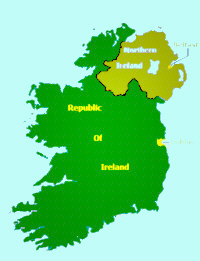
Ireland is subdivided into four provinces: Connacht, Leinster, Munster,
and
Ulster – interesting that 'King Coniah' was the last legitimate king of
Judah.
Connacht, means 'land of the
descendants of Conn'. Wow! What a
cookie crumb, huh? #3659 Coniah: {Konyahuw} means 'The Lord will
establish'.
Coniah is another name for King Jehoiachin of Judah, the next to last
king on
the throne before the captivity. Zedekiah, aka Mattaniah, was the last
king of
Judah, placed on the throne by Nebuchadnezzar, so legitimately, by
natural
succession, Coniah was the last rightful kind of Judah. More than
likely, it
was the daughters of Coniah that Jeremiah took to the Isles, and not
the
daughters of Zedekiah.
In Ireland over the last 1,000
years, there have been influences by the Vikings and the Normans, but
Basque
influence over the Irish produced the 'black Irish'. Recent DNA
evidence shows
that there may have been Celto-Basque cultural contact through the
immigration
of the Galacians from Spain and France, known as the pre-Celtic, which
would
account for the high factor of Rh negative blood found amongst the
Celtic
peoples than there is in Germanic peoples. This may also account for
the 'black
Irish', which were not black in skin tone, but they have black hair and
darker
eye color, vs the reddish-blonde hair and blue or green eyes of most
Irish. For
this reason, the Irish were not always thought of as being altogether
white,
combined with their religion of Catholicism, which Protestants dislike,
set the
stage for discrimination. Much anti-Irish sentiment grew into long and
constant
hatred after the great potato famine migration of the 1840's, which led
to the
Irish being called, 'Irish niggers'; the two despised groups [Catholic
Black-Irish and Negroes], were often lumped together at the bottom of
the
American barrel by Protestant citizens.
Simeon
and Levi together as brethren. were instruments of cruelty in their
habitations. They were to be separated one from another, which they are
today
by water, government, and religion. While many Irish/Simeonites are
Catholic,
the Levites are mostly Christian Protestant.
Is
it any wonder - if Simeon really was guilty
of construing to kill his brother Joseph that he would become plagued
with
karmic debt. Considering that the Irish have suffered greatly for no
other
obvious or apparent reason, it could be the sins of Simeon hanging
around to
haunt them, or the curse of Jacob for his trouble with them. But when
all is
said and done, you’ve just got to love the Irish – see, when it comes
to the
Israelites, things can change for the better.
|